
Solar Market Insights
3 minute read
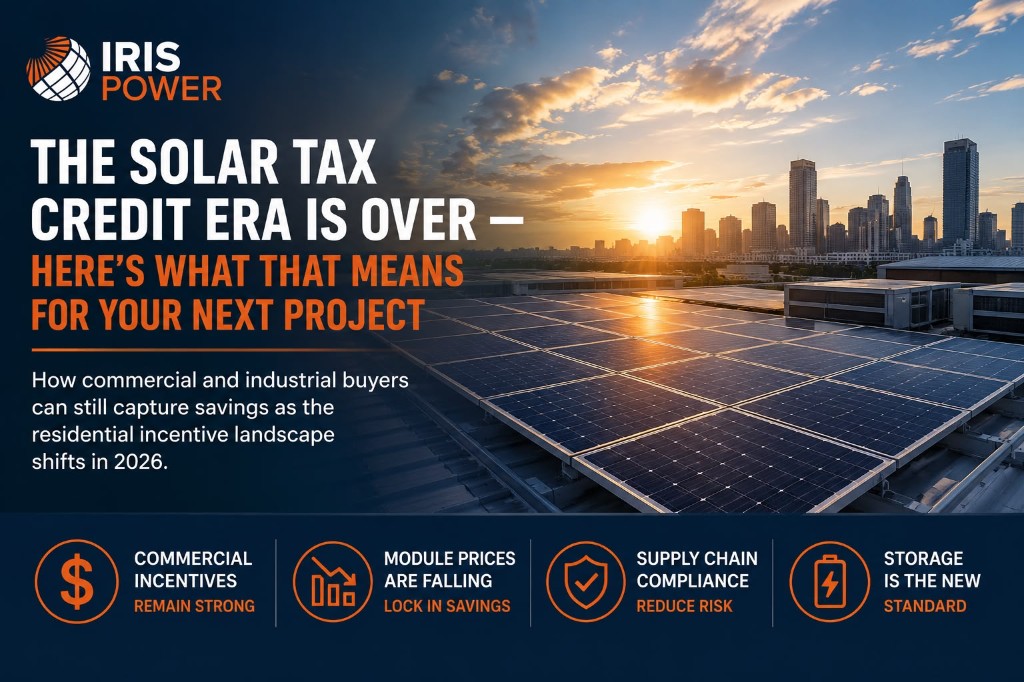
If you’ve been following solar news this year, you’ve probably noticed the same headline repeating: the residential solar tax credit is winding down, and the industry is scrambling to adjust. For homeowners, this marks the end of an era. But for commercial and industrial (C&I) buyers, the story looks very different — and in many ways, more favorable.
At Iris Power, we work with businesses across the solar supply chain every day, from module procurement to project financing, and we’re seeing this shift play out firsthand. Here’s what’s actually changing, and what it means if you’re planning a solar investment in 2026.
The residential 25D tax credit, which for years drove homeowner adoption, is being phased out. That’s pushed residential solar companies to rethink their entire sales model, shifting from transactional, incentive-driven pitches toward long-term value: efficiency, reliability, and service.
Commercial and industrial solar tells a different story. The Section 48 Investment Tax Credit and related provisions remain in place for businesses, meaning warehouses, manufacturing facilities, schools, and other commercial properties can still capture significant savings on solar installations. If your business has been sitting on the fence about going solar, this incentive gap between residential and commercial makes now a particularly good time to move — before further policy shifts narrow that window.
One trend that hasn’t gotten enough attention: solar module prices are dropping across nearly every market segment. Recent industry pricing data shows commercial system costs actually rising slightly year-over-year, while the underlying driver — module prices — has been declining across residential, commercial, and utility-scale segments alike.
For businesses sourcing panels, this is a rare moment where higher-efficiency modules, including Qcells’ TOPCon and heterojunction lines, are becoming more accessible at lower per-watt costs than in previous years. Buyers who lock in pricing now, while module costs are favorable, are positioning themselves ahead of potential tariff or trade-related cost increases down the line.
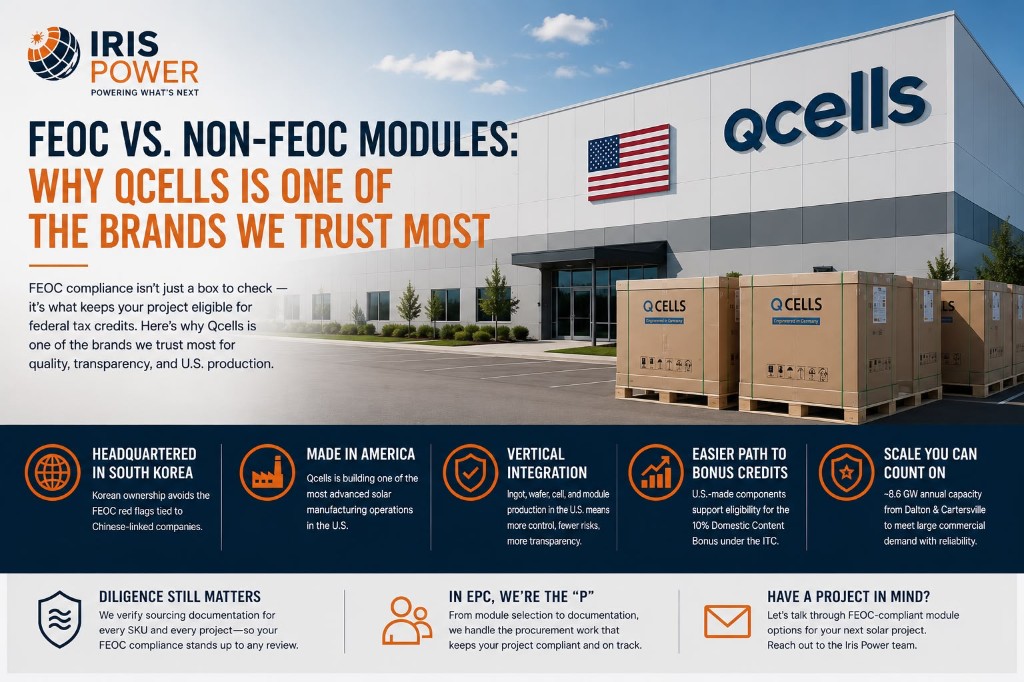
It’s worth being upfront: the solar manufacturing sector is still navigating uncertainty tied to foreign entity of concern (FEOC) sourcing rules and ongoing trade cases. No new module manufacturing capacity was added domestically in the first quarter of 2026, which means sourcing decisions matter more than ever.
This is exactly why procurement partners matter. Working with a supplier who understands compliant sourcing, has established vendor relationships, and can navigate documentation requirements — POs, invoicing, and compliance paperwork — takes a major risk off your plate, especially for larger C&I projects where a sourcing misstep can delay a project by months.
The other major shift happening alongside the tax credit transition is the rise of solar-plus-storage as the standard, not the add-on. Nationwide, energy storage deployments are projected to reach roughly 35 GW / 70 GWh in 2026, with strong growth on both the residential and C&I side.
For commercial buyers, pairing storage with a solar installation isn’t just about backup power anymore — it’s about peak shaving, demand charge reduction, and, in some markets, direct revenue through grid services. If you’re evaluating a solar project this year, ask your supplier whether storage integration is part of the conversation. It should be.
At Iris Power, we help businesses navigate exactly these decisions — from sourcing high-efficiency modules to structuring purchase orders and invoicing that keep projects moving without surprises. If you’re evaluating a commercial solar project this year, we’re happy to walk through your options.
Interested in learning more about commercial solar procurement or current module pricing? Reach out to the Iris Power team.