

Solar Market Insights
3 minute read
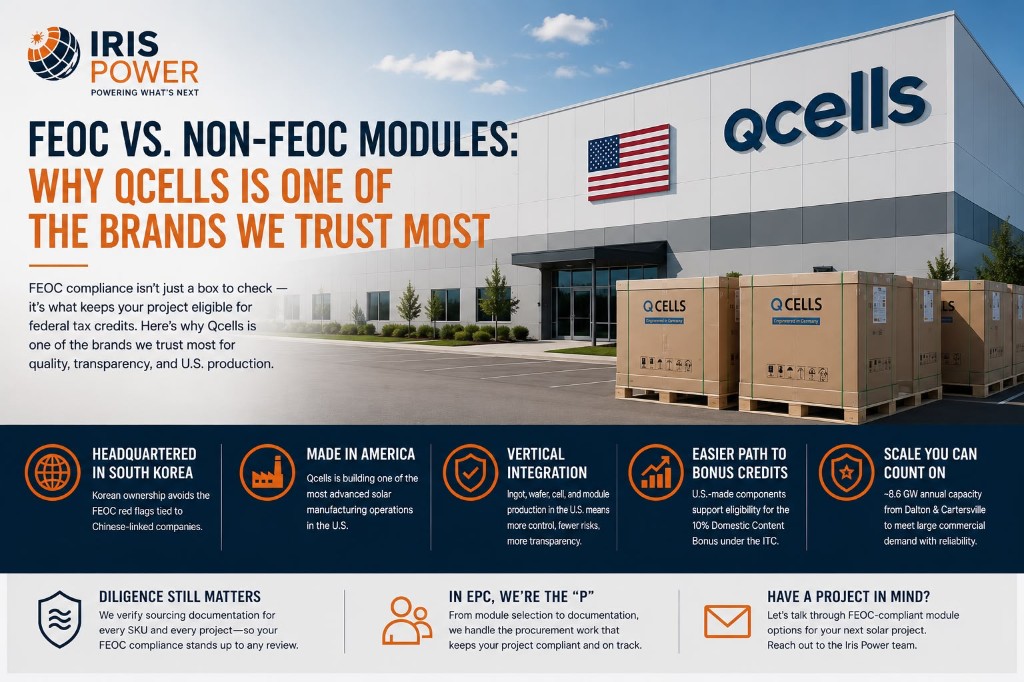
Every commercial solar buyer is hearing the same phrase this year: FEOC compliance. But once you get past the acronym, the real question is simpler: which modules can you trust to keep a project eligible for federal tax credits? At Iris Power, that question comes up in nearly every sourcing conversation — and Qcells is consistently one of the brands we point buyers toward.
FEOC — Foreign Entity of Concern — refers to restrictions under the One Big Beautiful Bill Act that block certain federal tax credits when a project receives too much material assistance from a Prohibited Foreign Entity (PFE). In practice, that means companies with significant ownership, debt, or control ties to China, Russia, North Korea, or Iran.
For solar modules specifically, the project-level threshold in 2026 requires at least 40% of manufactured product costs to come from non-PFE sources, a number that climbs each year. A module isn’t automatically safe just because of the brand printed on the frame — the calculation depends on where cells, wafers, and underlying components came from, and whether the manufacturer can document that clearly.
Qcells (Hanwha Qcells) is headquartered in South Korea, a distinction that matters immediately since Korean ownership doesn’t carry the same FEOC red flags as Chinese-linked manufacturers. That alone puts Qcells in a fundamentally different risk category than many lower-cost alternatives.
Qcells has been building out a vertically integrated U.S. manufacturing operation, with facilities in Dalton and Cartersville, Georgia. As of mid-2026, Qcells began producing solar cells at Cartersville alongside its existing ingot and wafer lines — moving toward the ability to make ingots, wafers, cells, and finished modules on U.S. soil. Few manufacturers can make that claim at scale.
Qcells is one of the strongest options on the market, but no brand is a blanket guarantee. Its supply chain has faced real scrutiny: in 2025, some Korean-made cells were briefly detained by U.S. Customs under the Uyghur Forced Labor Prevention Act over polysilicon sourcing concerns before normal production resumed. That illustrates the broader point: even a manufacturer with strong fundamentals and heavy domestic investment needs its specific product line and sourcing documentation verified project by project. FEOC and domestic content status can vary by product SKU and manufacturing batch, not simply by brand.
That is why Iris Power does not simply tell clients to buy Qcells and not worry about it. Sourcing documentation for the specific modules going into a specific project is verified every time.
Qcells earns its place on our recommended list because of where it is headquartered, how aggressively it is investing in U.S. manufacturing, and the transparency that vertical integration provides — not because any single brand replaces real diligence. For buyers navigating FEOC rules without becoming compliance experts, working with a manufacturer that has built around U.S. production can make the path considerably easier.
Module selection is only one piece of staying compliant. Sourcing decisions, documentation, and paperwork all have to hold together at the project level — exactly the work Iris Power handles for EPCs and developers day to day. In EPC, we’re the P.
Sourcing modules for an upcoming project and want to talk through FEOC-compliant options? Reach out to the Iris Power team.
This article is for general informational purposes and isn’t tax or legal advice. FEOC status can vary by product line and changes as manufacturers update their supply chains — always confirm current documentation with your supplier and a qualified tax professional before relying on any manufacturer’s compliance status.