

Solar Market Insights
3 minute read
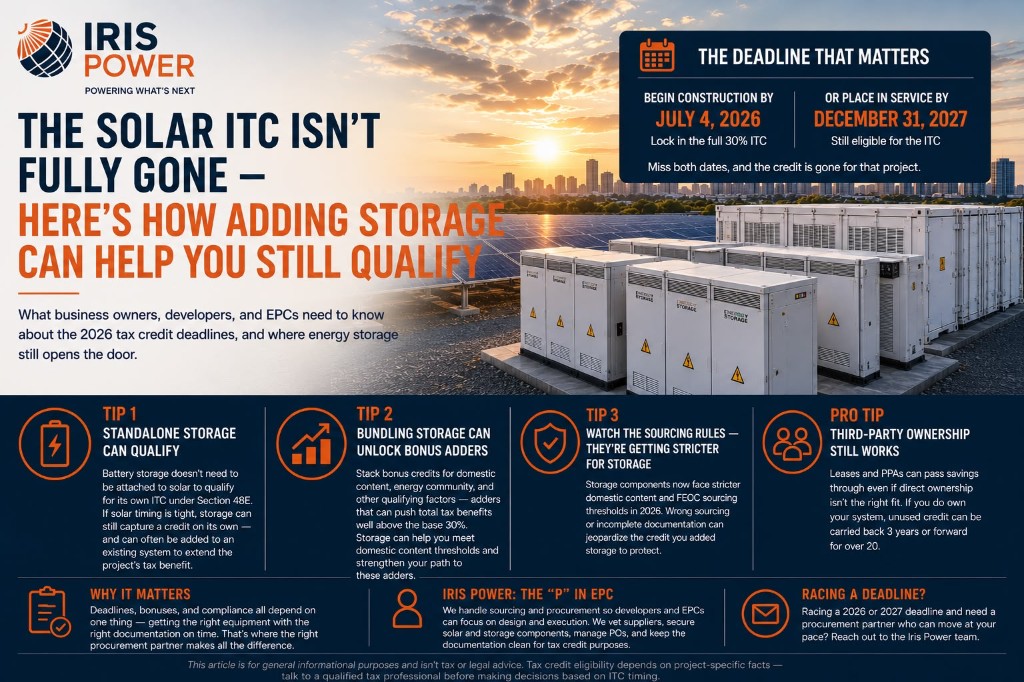
If you’ve heard “the solar tax credit is dead,” you’ve heard half the story. The residential 30% credit for cash and loan purchases did end after December 31, 2025. But for businesses, nonprofits, and developers, the commercial Investment Tax Credit under Section 48E is still very much alive — and pairing your project with energy storage is one of the smartest ways to protect your eligibility as the rules tighten.
Here’s what’s actually changed, and the practical tips that still work in 2026.
The commercial ITC didn’t disappear — it just moved to a hard deadline. Projects that began construction by July 4, 2026 lock in the full 30% credit. If that date already passed for your project, there’s still a path: systems that are fully placed in service by December 31, 2027 remain eligible. Miss both dates, and the credit is gone entirely for that project.
That makes the next 18 months the real window. If you’re a business or developer still weighing a solar decision, the practical question isn’t “should I go solar” — it’s “can I get this project moving in time to qualify?”
Battery storage doesn’t need to be attached to a solar array to qualify for its own investment tax credit. Standalone storage systems above a minimum capacity threshold are independently eligible under Section 48E. If your solar timeline is at risk of missing the construction or placed-in-service deadlines, storage can still capture a credit on its own and can often be added to an existing or in-progress solar system as a way to extend the project’s tax benefit.
Beyond the base 30%, projects can stack bonus credits for domestic content, energy community location, and other qualifying factors — adders that can push total tax benefits well above the base rate. Storage components factor into these calculations too, and in some cases a solar-plus-storage system has an easier path to hitting domestic content thresholds than solar alone. Structuring equipment sourcing around these adders from day one is far easier than trying to retrofit compliance later.
For smaller systems, incurring a meaningful percentage of total project cost early can establish “begun construction” status and lock in eligibility, even if physical installation stretches into next year. Larger projects have their own construction-activity tests. The paperwork and procurement decisions made now determine eligibility later, not just the date the system gets switched on.
Storage components now face their own domestic content and foreign entity of concern (FEOC) sourcing thresholds. A battery system with the wrong sourcing paperwork can jeopardize the very credit you added it to protect. Projects often run into trouble late in the process not because the equipment is wrong, but because the sourcing documentation doesn’t hold up.
If your business doesn’t have the tax appetite to use a large credit in one year, direct ownership isn’t the only option. Third-party ownership structures, including leases and PPAs, can still pass savings through where a straightforward purchase wouldn’t make sense. Businesses that own their systems outright can also carry unused credit back three years or forward for over two decades.
None of these tips matter if the equipment doesn’t show up on time with the right documentation. Safe harboring, domestic content bonuses, and FEOC compliance all live or die on procurement — knowing which suppliers can deliver compliant components, on what timeline, with the paperwork to prove it.
Iris Power handles sourcing and procurement for EPCs and developers who need to move fast and stay compliant: vetting suppliers, securing solar and storage components, managing purchase orders, and keeping the documentation clean for tax credit purposes. Simply put — in EPC, we’re the P.
Racing a 2026 or 2027 deadline and need a procurement partner who can move at your pace? Reach out to the Iris Power team.
This article is for general informational purposes and isn’t tax or legal advice. Tax credit eligibility depends on project-specific facts — talk to a qualified tax professional before making decisions based on ITC timing.